Sunday, October 20, 2013

Safe in the Lords Hands - Psalm 121

Preached 20 Oct 2013 at Christ Church, Billericay at the 08:00 spoken communion.


Introduction


Join me on a pilgrimage. We do this three times a year. We pack up the whole family and travel to Jerusalem for the festival. Its a long way, and we will be gone for quite a time. From Capernaum on the northern shore of Galilee, where I live it is 90 of your milesi if I go by the most direct route, but that would mean going through Samaria. That's a hostile region, so we will have to go around it. That will make the journey about 120 miles, or sixii days. We will have to pack food and water for the journey, and of course tents for shelter. We have donkeys to carry all of that – and don't think you would get to ride on them, they are much too important for that!
The last part of the journey is hardest as we have to climb the hills up to Jerusalem. It's there that some of the some of the family get a little disheartened – but we have our songs to keep us going. They remind us of the Lord, and how good he is to us. We sing them every time, so we know them even better than you know your Christmas songs. We don't need scrolls, or books – the children learn them by repetition and will know them very well by the time they are seven years old. We call them 'Songs of ascent' because we sing them as we begin the long slow walk up the hills to Jerusalem.
That one you heard this morning can be used as a challenge and response, it has 4 simple verses, lets give it a try so you know how we sung it, then I'll tell you a bit about what it means to us:
L: I lift up my eyes to the hills— where does my help come from?
A: My help comes from the LORD, the Maker of heaven and earth.


L: He will not let your foot slip — he who watches over you will not slumber;
A: indeed, he who watches over Israel will neither slumber nor sleep.


L: The LORD watches over you — the LORD is your shade at your right hand;
A: the sun will not harm you by day, nor the moon by night.


L: The LORD will keep you from all harm —he will watch over your life;
A: the LORD will watch over your coming and going both now and forevermore.

vv 1 and 2

I lift up my eyes to the hills— where does my help come from?
My help comes from the LORD, the Maker of heaven and earth.
We look up to the hill as we approach them and as we slowly climb them. There are lots of dangers in the hills. There are bandits, large groups of them, they can ambush you and steal all your money and provisions, they will even take your clothes, and some will kill you if you try to fight back. There are also bears and lions prowling around. Most of them won't come near a human settlement, but sometimes we will have a visitor to the camp in the dead of night.
The other danger is temptation. Jeremiah said “Surely the idolatrous commotion on the hills and mountains is a deception; surely in the LORD our God is the salvation of Israel” and he was right, only the Lord our God can save us. We must avoid the shrines and alters of the high placesiii because they are dedicated to the gods. Some to Baal, you'd think they'd have given up on him by now, but well, they don't seem to have. Baal is nothing really, the Lord our God made everything you can see, that is where our help comes from.

vv 3 and 4

He will not let your foot slip — he who watches over you will not slumber;
indeed, he who watches over Israel will neither slumber nor sleep.
The Lord our God watches over all of us, all the time. He is an attentive God and is interested in his people. The paths we follow are not like your lovely roads, they are dry and dusty and strewn with rocks and stones. It is easy to trip or turn an ankle if you do not pay attention. There is nowhere to get help on our roads, there are no emergency services, there are no service areas, no hotels, no toilets. If you are hurt here there is only the family and the Lord God to help you.
Baal sleeps, if you worship him, you might have to wake him up to get his help. The Lord God does not sleep, He doesn't even doze, He is never tired, He is awake and watching over us all the time. Now some of you might think that being watched all the time was not a good thing, but we know the Lord God cares for us so we are pleased that He is always there.

vv 5 and 6

The LORD watches over you — the LORD is your shade at your right hand;
the sun will not harm you by day, nor the moon by night.
The Lord watches over us, we remind ourselves of that a lot – it is easy to forget – especially when bad things happen to us, but He is always there watching over us. On our pilgrimage we might encounter some high temperatures, so make sure you have a hat, or a turban if you've got one. The sun on your head can make you very ill. Make sure you have light clothes too, to reflect the heat from your body. Temperatures can reach 120 F (or 40 C) and there is very little shade in the hills.
That word 'shade' can also mean 'shadow'. The Lord God is like our shadow, always with us, never leaving us on our own. We use this image to talk about oppression, just as the shade protects from the oppressive heat of the sun, so the Lord protects us from oppression.
Some people believed that being caught in moon light can make you insane, it is a belief that your ancestors had – your word lunatic comes from the old word luna that means moon. For us this is just additional confirmation that the Lord God is watching over us even at night, even when your shadow is caused by the moon and not the sun, so that the moon cannot harm you.

vv 7 and 8

The LORD will keep you from all harm —he will watch over your life;
the LORD will watch over your coming and going both now and forevermore.
God protects us, just like we protect our children. When you have a small child like my little grandson you don't let him play in the road, you prevent him going up or down stairs on his own, you put covers over the electrical sockets, even if they can't be opened without a plug. You don't protect him from walking across the floor, even though he might fall flat on his face – because walking is something he's got to learn, and falling helps him to learn. If he doesn't learn that his mother is going to struggle carrying him for six days – that's OK when he's a baby, but not when he's bigger!
That's just how the Lord is with us – he protects us from the things that will harm us, but he doesn't stop us experiencing the hurts that will teach us how life works. As it says in Deuteronomy (28:6) “You will be blessed when you come in and blessed when you go out.” Whether we are coming or going the Lord is protecting us.

Conclusion

So that's a little about how we view the psalm, but the best thing we can do is to learn it, so lets try it again


L: I lift up my eyes to the hills— where does my help come from?
A: My help comes from the LORD, the Maker of heaven and earth.


L: He will not let your foot slip — he who watches over you will not slumber;
A: indeed, he who watches over Israel will neither slumber nor sleep.


L: The LORD watches over you — the LORD is your shade at your right hand;
A: the sun will not harm you by day, nor the moon by night.


L: The LORD will keep you from all harm —he will watch over your life;
A: the LORD will watch over your coming and going both now and forevermore.


Next time you're travelling, say the travellers psalm and remember that the Lord God is protecting you.

References

i http://wiki.answers.com/Q/What_is_the_distance_from_Jerusalem_to_Capernaum&altQ=How_far_was_Capernaum_from_Jerusalem
ii 20 miles a day - http://www.blessitt.com/Inspiration_Witness/MilesJesusandMaryWalked/MilesJesusandMaryWalked_Page1.html
iii http://www.gotquestions.org/high-places.html
The Expositors Bible Commentary Volume 5
NIV Bible Study Notes (Pradis)
From Sermon Central.com:
God?s Protection in Times of Danger by Howard Harden
Who Ya Gonna Call? by John Beehler
"Powerful Protection" by Robert Leroe
Your Help Is On The Way by Levi
Help From On High by Steve Shepherd
Saturday, September 14, 2013

Modelling the Gospel


Preached at St Mary the Virgin, Little Burstead on Sunday 8 September 2013 at 10:30am

Purpose: To understand how Paul modelled the gospel message for Philemon and Onesimus.

Reading Philemon 1:1-21  

Introduction

Isn't it strange where the Lectionary readings end, what's wrong with the last four verses?  Well perhaps the final greetings could be left out, but v22 is fairly important to the tone of the letter.
We will look at this letter as a whole and examine our reaction to it, deal with some of the issues it raises and finally look at the doctrine of Atonement and especially Substitutionary Atonement.  Academics like using long words to describe things that most of us think are quite straight forward, so please don't switch off as we get towards the second part of the sermon.

Onesimus

So let’s look at the characters and see what we know about them and their situation.  I'll start with Onesimus as he seems to be the focus of attention.  His name means 'useful' and he is a runaway slave.  We have no idea why he ran away.  There are speculations that he was a thief, this is based on verse 18, but this may not be the case. Another speculation is that he was badly treated, but we have no evidence for that at all.
Somehow on his journey he had come into contact with Paul, and at some point converted to Christianity.  That's why he's called 'my son' by Paul in verse 10.  It seems that he has changed (as you'd expect) and is now living up to his name.  He is useful to Paul.
He is also mentioned in Colossians 4:9 where Paul’s writes:
He is coming with Onesimus, our faithful and dear brother, who is one of you. They will tell you everything that is happening here.
It's difficult to tell whether this is a result of Onesimus returning and being freed to go and work with Paul, or whether Paul still does not know he is a runaway slave.

Philemon

The letter is written to Philemon, he and his wife Apphia host a church and Archippus is most probably his son.  Paul clearly knows them all well.

Paul

The Apostle Paul was in prison for preaching the Gospel, and therefore 'a prisoner for Christ' not a prisoner of Christ!  Being in prison was something Paul had become familiar with.  The likelihood here is that he was in Rome under house arrest – perhaps one of the better imprisonments.  He couldn't leave, but he could have open communication with his visitors, and have any visitors he liked.

Reactions to the letter

Now that you know a little about the situation, I wonder how you react to the letter.  Put yourself in Philemon's place.  Your slave has run away, perhaps years ago, then he turns up with this letter from Paul – the person who was instrumental in your conversion and helped you found the church.  One commentator I read said they would be hopping mad to have received a letter like that (not the phrase they used exactly).  It is designed to give Philemon very little choice -
v 9&10 “I could be bold and order you … instead I appeal to you in love”
– When is an order not an order?  How ever you phrase your request, it still sounds like an order.
v11 I am sending him—who is my very heart—back to you.
– He's my closest friend while I'm in prison, but I'm sending him to you ...
v12 I would have liked to keep him with me so that he could take your place in helping me while I am in chains for the gospel.
– You're not here helping me as you should be, but he is and I'd like to keep him!
… and he goes on like this until in verse 16 he ups the stakes.  So that you can have him back “better than a slave, as a dear brother”
Finally, in the verse we shouldn't have read there is the hope (threat) that Paul will soon visit Philemon.

Issues – Slavery

Apart from the tone of the letter another major issue that is raised is Slavery.  Nowhere does the Bible condemn slavery, it is part of the status quo.  We should not think of slavery in the same terms as the slave trade though.  Most slaves were either captured prisoners from conquests, or had fallen into debt, or had been born into slavery.
A Roman slave would often have been considered part of the family.  They were paid and were often professional people including doctors and teachers.  Children born into slavery were educated.  A slave who did well could buy his freedom, and many did.  So many that the laws about freeing slaves had to be tightened, but that was well after this period.
Some slaves though were treated poorly, especially those on the farms and in the mines.  Slaves were subject to corporal punishment and it was common for runaways to be executed.  There was a great fear of slave revolts and it was illegal for a Roman citizen to harbour a runaway slave.
Slaves could be traded in the market place or in private sales, in some places they were even sold in shops.  A slave would cost you about the same as a donkey[1], but a good slave might be 500 denarii[2] (500 days wages for a labourer).  Slavery was an important part of the economy of the empire.
Having said all of that we still find the idea that one man can be the owner of another abhorrent.  It goes against everything we believe about a God who loves us as individuals and created us to live for him.  I believe that it is passages like the one that we are looking at today that ultimately undermined the system of slavery, so while the Bible doesn't condemn slavery, it has brought it to an end – at least as a legally and economic process.
FF Bruce “What this epistle does is to bring us into an atmosphere in which the institution could only wilt and die”[3]

Doctrine: Substitutionary Atonement

Now we must move on to doctrine.  The doctrine of Substitutionary Atonement.
Before I explain it, and why it is worth talking about here is a simple illustration  that will help us all understand what I'm talking about.
Illustration[4]
A man was caught stealing milk that had been delivered to a shop. He had been arrested and he was taken to court. The judge asked him, “How do you plead?” There was only one way he could plead, because he had been caught in the act. He had to plead guilty. He asked for leniency for he had two small babies at home and nothing to give them and instead of seeing them starve he resorted to stealing. He said, “Judge, I plead for the mercy of the court.” The judge said that since he had pleaded guilty, he had no alternative but to find the man guilty and he assessed a fine. The fine was ten pounds. The man stood there, crestfallen, for he anticipated a jail sentence since he had nothing with which to pay. Then the judge got up, laid down his gavel, walked off the bench, walked over to the clerk’s desk and paid the £10.00 himself, and set the man free. Then, he approached the man and wrote him a cheque for £100 to provide for his need.
There was no question of guilt, nor of the justice of the sentence. And yet the one who had had to find him guilty, was the one who had paid his indebtedness in order that he might go free.

Substitutionary Atonement

That is Substitutionary Atonement.  Someone else pays the price for our failings, and we are free to go.  Substitutionary because it is not us who pays, Atonement because we are put right with the person we have offended.

Substitutionary Atonement – Real Life example

Here's how it works in real life:
During the war between Britain and France, men were conscripted into the French army by a kind of lottery system. When someone’s name was drawn, he had to go off to battle.
There was one exception to this, however. A person could be exempt if another was willing to take his place.
On one occasion the authorities came to a certain man and told him he was among those who had been chosen. He refused to go, saying, "I was shot 2 years ago."
At first they questioned his sanity, but he insisted that this indeed was the case. He claimed that the military records would show that he had been conscripted 2 years previously and that he had been killed in action.
"How can that be?" they questioned. "You are alive now!"
He explained that when his name came up, a close friend said to him, "You have a large family, but I am not married and nobody is dependent upon me. I’ll take your name and address and go in your place." And that is indeed what the record showed.
This rather unusual case was referred to Napoleon Bonaparte, who decided that the country had no legal claim on that man. He was free![5]  Someone else had complete the service he owed and died in his place, the debt had been paid once and could not be due again.

Gospel and the letter to Philemon

It is like that for us.  Jesus has died in our place.  He is the payment for our sins, and because He is the payment, we are free, we are made right with God.
It is exactly the same argument that Paul is using in today's reading when he says to Philemon in verse 18:
“If he has done you any wrong or owes you anything, charge it to me”
We know that Onesimus owed Philemon something, even if he was not a thief, he still owed Philemon the time that he had been missing, or possibly the cost of his replacement.
Whatever it was Paul would pay, because Onesimus couldn't, and Paul loved Onesimus.
Paul also knew the Gospel, he knew that ultimately none of us can pay what we owe.  All of us are reliant on Jesus for our freedom from sin and our acceptance by God.
We can see the parallels with the Gospel in this letter:
Philemon is God, with a legitimate claim on Onesimus (who represents us).  Paul is Christ, paying the price and ensuring that the return is possible.  Paul is being a good Christian and doing what Jesus did. Paul is doing what we are all called to do, but he is taking a risk.

Risks and Costs

Paul
Even though he was already in prison, harbouring a runaway slave was punishable by death.  We must assume that only Paul knew who Onesimus really was, otherwise he would have been in big trouble immediately and his guards would have handed him over straight away.  As soon as he found out he would have been thinking about how Onesimus should be returned.
Paul has written a very strong letter to one of his converts demanding a very unpopular and difficult course of action.  There was a chance that Philemon would be offended and not do as Paul wanted, in that case the church that Paul had invested so much effort in would have failed.
Onesimus
Onesimus knew he had to return, if there was any argument it is not recorded.  He also knew he was taking a risk.  Even with the letter in his pocket, perhaps especially with the letter in his pocket, travelling back would be dangerous.  Not nearly as dangerous as arriving though.  It was common for a runaway slave to be put to death immediately they returned as a deterrent to the others.
Philemon
If Philemon was to accept Onesimus back as a slave and without punishment he would be unpopular with his fellow slave owners.  If he accepts him back and then gives him his freedom he is going to be more than unpopular, he will be seen as encouraging rebellion.

Ending

So, what happened?  I hate stories where you don't get a proper conclusion to the events, especially when those stories are about real people.  Well we don't know, if there was a record it is lost is history.
Well there was a bishop in Ephesus called Onesimus (after Timothy) who collected together the letters of Paul and this document was in that collection.  There is no evidence that they were the same person, but it makes for a good end to the story.
 

Sunday, September 01, 2013

Be Humble

Purpose: To understand the meaning of humility and how to be humble.

Background

My preparation for this talk started the day before we were to attend the wedding of my God son.  I re-read the passage in the morning before we headed out to the church.  You can imagine I was very careful where I sat in the church.  Once you get to the reception there is nothing to worry about as there are always seating plans and name cards in every place, so I could relax and enjoy the company and the good food.

Seating Plan

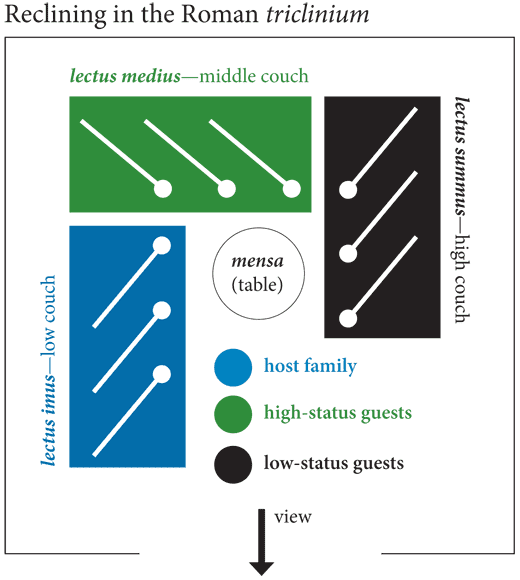
Jesus is only using the wedding as an example because he has observed the unholy clamour to find a seat at this dinner party.  They did not sit around a table like we do, but reclined on couches leaning on their left elbow.  
They sat round the table in a 'U' shape with the high status guests at the top of the table and the hosts on their right.  Lower status guests sat on the other side where it was harder to talk to the hosts and less comfortable to eat.
The higher status guests would arrive later (fashionably late!), so that they could be seen to be taking the high status positions, and presumably so that they could see the lower status people humiliated by being moved down the hierarchy to a worse seating position.
Jesus is clearly not impressed by what He has seen.  He knows that He is there to be watched, evaluated, or even trapped, and is going to have His say, so He tells them the parable.  He says they should take the seat that has the lowest position, so that the guests will see them promoted rather than being humiliated by a demotion.  He ends by saying in verse 11:
For everyone who exalts himself will be humbled, and he who humbles himself will be exalted.

Hierarchy in the Classroom

[only if there are children present]
I suspect that most of the time we know our place in the hierarchy.  I remember hearing about a study that said each child in a class knew who was above them and who was below them.  It range true for me.  Is it still like that?
Well I suspect that it is – and that's not what Jesus wants for us, so what can we do about it?
Humble / Humbled – a definition.
[skip if there are children present]
Humble is a very badly misused word.  It means
1. Marked by meekness or modesty in behaviour, attitude, or spirit; not arrogant or prideful.
2. Showing deferential or submissive respect: a humble apology.
3. Low in rank, quality, or station; unpretentious or lowly: a humble cottage.
Which is exactly the way it is used in the gospel reading.
Humbled is also badly misused.  It means:
1. To curtail or destroy the pride of; humiliate.
2. To cause to be meek or modest in spirit.
3. To give a lower condition or station to; abase.

Humble: misuse

Humble and humbled are very often misused
[common section]
So when some actor says that receiving this award is a humbling experience what they really mean is “Is this all I'm getting, I was expecting something better”
or when some dignitary after being knighted tells us what a humbling experience it was, they really mean they expected to be made a Lord, or even King.
No!, you were not humbled, being humbled would mean that your work is trashed, and the things you have are taken away from you.  When Fred Goodwin (formerly head of RBS) and James Crosby (formerly head of HBOS) had their Knighthood removed – THAT was a humbling experience.
Here's how Paul Annet puts it in his blog entry 'Humble Misuse':
If you were at the top of your game but luck dealt you a bad hand and you ended up begging on the street, that would be humbling. If you were at the top of your game but you spent a few days on the streets to raise awareness for a homeless charity, you may find the experience to be humbling in a rewarding, learning-from-it sense.1

Humility for us

For Jesus, and therefore for us it is all about putting others first.  This is what Paul said:
Phil 2:5-8 Your attitude should be the same as that of Christ Jesus:  Who, being in very nature God, did not consider equality with God something to be grasped, but made himself nothing, taking the very nature of a servant, being made in human likeness. And being found in appearance as a man, he humbled himself and became obedient to death — even death on a cross!
So for us to be saved Jesus had to humble himself and be obedient to God.
Phil 2:9-11 Therefore God exalted him to the highest place and gave him the name that is above every name, that at the name of Jesus every knee should bow, in heaven and on earth and under the earth, and every tongue confess that Jesus Christ is Lord, to the glory of God the Father.
Humility will certainly be rewarded in heaven, it is also a good way to live on earth
Pr 25:6-7 Do not exalt yourself in the king’s presence, and do not claim a place among great men; it is better for him to say to you, “Come up here,” than for him to humiliate you before a nobleman.
If we are obedient to God we will consider others more important than ourselves.
Jim Carey – Bruce Almighty clip
Submission is an act of humility.  If we don't submit to the will of God, then we will end up fighting with Him, and that can only end badly – with us being humiliated.  It should be easy to be humble in front of our creator, but most of us find even that really hard.
There's more to humility than submission to God's will.

John Wesley and George Whitefield

I've spoken about John Wesley and George Whitfield before, they were two great preachers of the 18th Century. Here is a story from the two men's lives that illustrates what humility is all about:
2John Wesley and George Whitefield had been great friends at Oxford, but they fell out over the Arminian/Calvinist debate.
The Calvinists say that God chooses us and the Arminians say that we are saved because we choose God
There was quite a bit of animosity between their followers.
Once one of Whitefield’s followers said to him:
"We won’t see John Wesley in the heaven, will we?" 
To which Whitefield humbly replied "Yes, you’re right, we won’t see him in heaven. He will be so close to the Throne of God and we will be so far away, that we won’t be able to see him!".
What a lovely attitude Whitefield had. His humility was real despite profoundly disagreeing with Wesley, Whitefield recognized John Wesley as being a man of God.  He shows us a basic humility that we can all try to copy.

Maximilian Kolbe

Some take it much further.
A catholic priest, Maximilian Kolbe provided shelter to refugees from Greater Poland, including 2,000 Jews whom he hid from Nazi persecution in his friary in Niepokalanów. On 17 February 1941, he was arrested by the German Gestapo and ended up inAuschwitz as prisoner #16670.
A protestant doctor who treated the patients in Kolbe’s block said that Kolbe would not let himself be treated before any other prisoners in that block. He sacrificed himself for the other prisoners. The doctor said about Kolbe: "From my observations, the virtues in the Servant of God were no momentary impulse such as are often found in men, they sprang from a habitual practice, deeply woven into his personality.”4
At the end of July 1941, three prisoners disappeared from the camp, the deputy camp commander, picked 10 men to be starved to death in an underground bunker in order to deter further escape attempts. When one of them, Franciszek Gajowniczek, cried out, "My wife! My children!", Kolbe volunteered to take his place.
In his prison cell, Kolbe celebrated Mass each day. He led the other condemned men in song and prayer.  Each time the guards checked on him, he was standing or kneeling in the middle of the cell and looking calmly at those who entered. After two weeks of dehydration and starvation, only Kolbe remained alive. The guards wanted the bunker emptied and they gave Kolbe a lethal injection. Some who were present at the injection say that he raised his left arm and calmly waited for the injection.
Kolbe considered others more important than himself – even to the point of offering his life in exchange for another.
He is an excellent example to us.  The doctor who treated the prisoners has seen something in Kolbe. Being humble is not part of our natural character.  Like so many other things of God, it must be cultivated until it becomes part of our second nature – our spiritual nature.
If Kolbe can give up his life for someone else, perhaps we can start by:
Inviting the misfit to our birthday party
Inviting those who don't fit in to our church events, and befriending them
Jesus talked about inviting the rejects from society, the poor, crippled, lame and blind, because to be humble means that there can be no pay back.  We probably treat the disabled better than they have ever been treated, but there is still a way to go.  There are also those who are on the fringes of society, those who don't fit in.
After all Jesus invited us to heaven – and we were nowhere near being qualified for entry.

Conclusion

I'm going to finish with story that shows that pay back can come when you're least expecting it.
Late on a stormy night in Philadelphia, an elderly couple walked wearily into a hotel. They approached the night clerk at the desk and practically begged him for a room. Apparently there were three conventions in town, and every hotel was filled to capacity. "Are there any rooms left anywhere?" the old man inquired.
"I’m sorry. All of our rooms are taken," the clerk said. "But I can’t send a nice couple like you out into the street and in the rain at one o’clock in the morning. Would you perhaps be willing to sleep in my room? It may not be what you’re used to, but it will be good enough to make you folks comfortable for the night."
When the couple declined, the young man pressed it."Don’t worry about me; I’ll be just fine,” the clerk said. “Just take my room.” So the couple agreed.
As he paid his bill the next morning, the older man said to the clerk, "You know what?
You are the kind of man who should be the boss of the best hotel in the United States. Maybe someday I’ll build one for you."
The clerk didn’t think much about that, and two years passed. The clerk had almost forgotten the incident when he received a letter from the old man. It recalled that stormy night and enclosed a round-trip ticket to New York, asking the young man to pay them a visit.
The old man met him in New York, and led him to the corner of Fifth Avenue and 34th Street. He then pointed to a great new building there, a palace of reddish stone, with turrets and watchtowers thrusting up to the sky.
"That," said the older man, "is the hotel I have just built for you to manage."
"You must be joking," the young man said.
"I can assure you that I am not," said the older man, a sly smile playing around his mouth. The old man’s name was William Waldorf Astor, and the magnificent structure was the original Waldorf-Astoria Hotel.

References / Sources


Friday, August 23, 2013

New Wine Article for the Christ Church Spotlight magazine

New Wine is a Christian Holiday that takes place in the Bath and West Show Ground at Shepton Mallet. Most people stay in a tent, Jo and I stayed at the Inn at the top of the hill. It is about 15 minutes walk to the centre of the show ground from there, which is about the same as some of the camp sites. There are hot drinks and other refreshments available in lots of places and a food court in the centre of the 'village'. This was our second visit to New Wine.
If you have never been the pattern of the day is breakfast, worship, seminars, lunch, seminars, evening meal, and worship. There are early morning and late evening activities too. The morning and evening worship sessions follow the same basic layout. There is up to an hour of singing followed by a talk of about 40 minutes, followed by ministry (people going forward for prayer).
Everything on offer is optional, we chose to attend morning and evening worship in the main venue each day and just a few seminars. There is an 'exhibition' in one of the large halls where you can get involved in all sorts of things, with many organisations offering all sorts of opportunities. There is also a bookshop. I had decided that I would do less seminars this time, two years ago I was overloaded with them and was not able to make use of all I had heard. This time I bought two books and decided to read as much of them as possible in the gaps between seminars. More on those another time – probably.
Here are just a few of the highs and lows from the week. These are my views and experiences, others will disagree. First the lows. I normally expect the sung worship at such events to be amazing, sadly this time it was not. On some occasions there were just too many songs that I didn't know. I learn songs more slowly than most so I found this frustrating. One exception to this was Rend Collective (look them up on the internet) who put on an amazing show one evening and still managed to lead us all in worship. Another low was the availability of Wi-Fi. Not an issue for some, but increasingly a problem in the modern world when it is unavailable. Wi-Fi access is limited to one hour, so taking and storing notes on my Samsung pad was difficult. I had to go back to paper and pen, and I still have lots of notes to process.
So that's the bad news out of the way, on to some of the good things. The Archbishop of Canterbury paid us a visit. He answered questions in a seminar and spoke and involved himself in the ministry one evening. The 'tent' was packed, its usual 6,000 capacity exceeded and it was very hot and humid, but well worth staying for. He comes across as a normal Christian, not a slightly out of touch academic, but even so it is easy to see that he is a very thoughtful and prayerful man. Among other things he spoke about his priorities for the church, which I have condensed into three short points:
  1. Prayer and revival
  2. Reconciliation
  3. New disciples
I attended a very interesting seminar (called “Faking Life”) on the issues that bio-technology is raising for Christian ethics. Sounds boring? Well try this: “If there was a drug that could increase your intelligence would you take it?” That was the opening question we were given to 'wake us up'. Of course, such a drug already exists, but more effective ones will be here soon.
Robbie Dawkins on Wednesday evening did 'healing by example'. He prays for the first person, they pray for the next person, using the words he gives them and so on, and it seemed to work, if to a rather limited extent. He said he has less success healing Christians than he does non-believers. That prompts some interesting questions to mull over in the next few weeks. There were lots of healing testimonies at every worship session in the main venue. I would like to hear from those people again in six months time to see how they're doing.
Then there was Steve Morris. “If your speaker can't get here ask the youth worker to have a go.” seems to be the attitude among a number of leaders, sometimes it fails, this was not one of those times. His young people had told him not to water it down – and he didn't. He talked about living with integrity and at one point by way of an example said that if everyone in the tent gave the price of a burger (£6 from the posh burger stall) then their project to build an education centre in South Africa would be paid for. There was no appeal, and it wasn't even a main point of his talk. Shortly after he said this I noticed more people moving around than was usual, then there were lots of people moving up to the stage. They were putting money on the stage. The leaders sent for buckets, but they were not enough, the people making donations were having to be directed. In total £34,000 was raised in about 10 minutes. We found out the next day that a prophecy given in the USA had predicted that the money would be given and it would look like it came from a watering can – a very apt description. This was an undoubted move of the Holy Spirit, especially because it took the leaders by surprise and they were slightly embarrassed by what happened. A real miracle and my high light of the week by a long way.
The main thing I like about New Wine is that the day starts and ends with worshipping and there are times when the Holy Spirit is moving – things happen! There is a lot more to think and pray about, and much of it will change us in ways we can't foresee.

Sunday, August 18, 2013

Praise under Pressure - Psalm 34

Purpose: To encourage praise of God

Reading: Psalm 34 

Praise under pressure

Did you get the start of this Psalm:
“Of David. When he pretended to be insane before Abimelech, who drove him away, and he left.
:1 I 63 will extol the LORD at all times; his praise will always be on my lips.
:2 My soul will boast in the LORD; let the afflicted hear and rejoice.
:3 Glorify the LORD with me; let us exalt his name together.”
Wow!  There is David, under threat of death and he can praise God like this. 
This is David's situation: Saul has taken a dislike to David and is trying to kill him, so David has run away.  We pick up the story in 1 Samuel 21:10-15
That day David fled from Saul and went to Achish king of Gath. 
But the servants of Achish said to him, “Isn’t this David, the king of the land? Isn’t he the one they sing about in their dances: “‘Saul has slain his thousands, and David his tens of thousands’?”
David took these words to heart and was very much afraid of Achish king of Gath. So he pretended to be insane in their presence; and while he was in their hands he acted like a madman, making marks on the doors of the gate and letting saliva run down his beard.
Achish said to his servants, “Look at the man! He is insane! Why bring him to me? Am I so short of madmen that you have to bring this fellow here to carry on like this in front of me? Must this man come into my house?”

Achish vs Abimelech / Attribution

Samuel says Achish, but the Psalm says Abimelech. That's probably because Abimelech  is a title for Philistine Kings.  You may also have noticed that the attribution at the top does not have a verse number.  That is because it is not part of the psalm, but it IS part of the ancient writings, so we read it when we read the psalm.  The headings that are inserted in a modern translation, such as “David at Gath” are modern additions, and are for our convenience.  Different translations will have different headings in different places.  We don't usually read them.

David's Attitude

While all this is happening David isn't praying for deliverance or safe passage, He's praising God. And thinking about how others might come to praise God as he is doing.

Psalm Structure

He writes the psalm down (or more probably dictates it) as an acrostic poem, where each of the verses starts with the successive letter of the Hebrew alphabet.  In doing so he breaks the model of the normal structure of a Psalm.
Here's the structure he comes up with:
1-7 Thanksgiving for God's goodness and justice
1-3 Individual or communal praise
4-7 Individual or communal experience.
8-22 In praise of Wisdom
8-14 Exhortation to wisdom
15-22 Rewards of Wisdom

Beginning of Wisdom

We're going to take a look at a few of the things that David says about wisdom, to help us understand more of what he is saying.  Then we will return to look at praising God.

v6 Poor

In verse 6 the word poor does not necessarily refer to poverty, but to those who do not have sufficient resources to defend themselves in the world, and therefore understand their need for God.

v7 & 9 Be afraid ...

Fear of the Lord we are often told really refers to respect.  Everything we do should be done thinking about God and how He would respond to it.  “The fear of the Lord is the beginning of wisdom” it says in Psalm 111:10 and Proverbs 9:10.  In verses 7 & 9 though it has the sense of  'be afraid, be very afraid,' be more afraid of God than any of His enemies.  That is a good attitude to have because only God can keep us from Hell, if He were to let go we would be lost, but He has promised not to.

v8 Taste, not test

At the start of the section “Exhortation to wisdom” in verse 8 David says “Taste and see that the Lord is good”.  Try it and see!  Try before you buy!  What an invitation that would make today!  Come to church and meet God and see if you get along with Him. 
We must remember though that we must not see this as testing God.  People are not coming along to see what God can do for them. It can never be “God I will follow you if you will ...” as it was with the Israelites at Massah where the demanded that God provide for them. (Deuteronomy 6:16)

v10 Lions

In verse 10, 'lions' is probably a metaphor for the go getting rich oppressors of the people.  Those who seek wealth and power rather than God.  They, David said, will have needs, but Gods faithful will not.  Although we may struggle with the idea that Gods people are never in need we should remember that David is writing from his own experiences.

v19-20 A prophecy?

'Bones' in verse 20 can be seen as a metaphor for Gods people, none of whom can ever be broken.  It is also literally true of Jesus who died on the cross before his legs could be broken to speed up the process.

v12-16 in 1 Peter 3:8-12

Peter uses verses 12-16 in his first letter as a way of describing how people should live.
1Pe 3:10 For, “Whoever would love life and see good days must keep his tongue from evil and his lips from deceitful speech.
1Pe 3:11 He must turn from evil and do good; he must seek peace and pursue it.
1Pe 3:12 For the eyes of the Lord are on the righteous and his ears are attentive to their prayer, but the face of the Lord is against those who do evil.”
“If you live like this who is going to cause you harm?” he says, and goes on to talk about suffering for righteousness, but reminds his readers not to fear.  He has picked up the message of the Psalm perfectly.

David's response is praise

David's response to any problem is to praise God.  He can only do this because he has experience of God's protection.  He has learned over many years to trust God.  He says as much in verse 17
The righteous cry out, and the LORD hears them; he delivers them from all their troubles.
And verse 19
A righteous man may have many troubles,  but the LORD delivers him from them all
We can see David's trust in the Lord by his attitude when the Israelites were threatened by the Philistines and their champion Goliath.

What has God done for us?

God has not rescued me from bears of wolves – not literal ones anyway but he has kept me safe through the years.  David was confident that God would give him victory because many time God had protected him from bears and wolves, so he volunteered to go and fight
Story?

Count your blessings

My mother always used to say to be when I was a grumpy child (quite often!) “Count your blessings”.  To a young boy its a horrible thing to say – I had no idea what my blessings were.    Now I know more about the world I realize that my blessings are considerable.  I live in a nice town, in one of the most peaceful and stable countries in the world. I have a reasonable job that provides for my family, life is mostly very good and very non-threatening.  I am greatly blessed with those things even before I start to talk about my family and by brothers and sisters in Christ.
Lets take a moment to give thanks to God for some of our more obvious blessings.

Testimony of the testimony

When we don't count our blessings and recognize all the good things that God has given us we can easily become grumpy and dissatisfied.
Many years ago I was coming to church as a habit – nothing more.  Things had not been going well for me here and I was fed-up and disillusioned with church and everything associated with it.  I had stopped praying and had stopped reading the Bible.  There was some event happening, I can't remember what or why – I wasn't that interested.  Captain Ron asked me to give my testimony, well not so much asked as demanded.  I reluctantly agreed.  I found when I spent time thinking about my history with Jesus that all I could do was praise Him. 
Its a good exercise to do – give it a try.
You have had the taste, now you can see that God is good.

Jehoshaphat wins by praise

Even so praising God is not the most obvious response to problems. Jehoshaphat found that it worked.  When the Moabites, Ammonites and some of the Meunites from Mount Seir teamed up to attack Judah Jehoshaphat sought God.  Here's how the battle went from 2 Chronicles 20:20
Early in the morning they left for the Desert of Tekoa. As they set out, Jehoshaphat stood and said, “Listen to me, Judah and people of Jerusalem! Have faith in the LORD your God and you will be upheld; have faith in his prophets and you will be successful.” 
After consulting the people, Jehoshaphat appointed men to sing to the LORD and to praise him for the splendor of his holiness as they went out at the head of the army, saying: “Give thanks to the LORD, for his love endures forever.”
As they began to sing and praise, the LORD set ambushes against the men of Ammon and Moab and Mount Seir who were invading Judah, and they were defeated.
The men of Ammon and Moab rose up against the men from Mount Seir to destroy and annihilate them. After they finished slaughtering the men from Seir, they helped to destroy one another.
When the men of Judah came to the place that overlooks the desert and looked toward the vast army, they saw only dead bodies lying on the ground; no one had escaped.
The battle was won, but only the enemy had fought.  Judah was victorious because of the praise they had given God.
I bet you didn't realise that “His love Endures forever” was a battle hymn did you?
Praising God defeats our enemy too!

Praise to start and end Prayer

Every time we come to the Lord we should start with praise and end with praise.  That's what Jesus taught us in the Lord's Prayer.
“Our Father in heaven, hallowed be your name” - that's praise – we are recognising God for who He is and telling Him that we have set even his name aside as something special.
It ends with “For the kingdom, the power and the glory are yours. Now and for ever.” praise again all glory belongs to God.

Conclusion

Psalm 34 was written in difficult circumstances. It starts with three amazing verses of praise.  David gives us the reasons for his praise of God by explaining what he has learnt of God as he has lived for Him and under His protection.
We can follow David's example by praising God for all that He has done at every opportunity and certainly at the beginning and ending of our prayer times.
The praise we give will help us to know God even better and then we too will respond with praise when we find ourselves in difficult circumstances.
Fear puts our problems between us and God.
Praise puts God between us and our problems.

Wednesday, July 24, 2013

This is how you should Pray - Matthew 6:0

Preached 9 September 2012 for Come Together ( a monthly less formal evening service)

Introduction

The passage is part of the Sermon on the Mount. Having already told the crowd how not to pray “Don't be like the hypocrites” in verse 5, and where to pray in verse 6 “go into your room and close the door”, he then moves on to tell them not to babble like the pagans in verse 7. He reminds them that God already knows their needs in verse 8 and them starts a template for prayer in verse 9.

Template for Prayer

That's right it's a template, it just provides a form, it wasn't meant to be recited every week, or every night, its a format for private prayer – not a corporate recital to be said together in church, or with the family at bed time. It's supposed to be “Subject headings”, if you like.
Commentaries will tell you that the Lord's Prayer has six petitions – 3 about God and 3 about us. We will be looking at the first of these today.
“Our father in heaven, hallowed be your name” or as the Amplified version says:
“Our Father Who is in heaven, hallowed (kept holy) be Your name.”

Translations

We should remember that we are reading English translations of a Greek document that is almost certainly written from hearing words spoken in Aramaic. Getting to the real meaning may not be that easy.
I'm going to look at the two phrases separately, almost word by word, so that we can see the ideas that Jesus is trying to communicate.

Our father in heaven

Our father in Heaven

We start by acknowledging who God is. When we pray, how often do we get straight into the list of wants and needs and forget to acknowledge God.

Our

Although the Greek word could be just as easily translated “My”, it never is. So I cannot suggest that God is in any way exclusive to me. And “our” in this sense does not imply that we can own God. It would imply ownership if I said “our house”, or “our car”, or even “our children” - depending on the context. Here though it's meaning is more like “our town”, or “our church”, or “our family” - it implies our belonging, rather than our possession.

Father

It's easy to say “God is my father”, but the experience we have of what a father is like, may not be that good. Many people will have had experiences of absentee fathers, angry or violent fathers, or just dis-engaged, uncaring fathers, or perhaps no experience of a father at all.
What ever your experience of your father as you were growing up, no-one's experience of their own father can match up to the perfect role that God takes on when He accepts us into His family.
Once we accept Jesus we become adopted children of God and are granted the privilege of calling him father. It shows us the type of relationship God wants with each of us.
This is what God says about his role as Father:
Psalm 68:5 A father to the fatherless, a defender of widows, is God in his holy dwelling.
Psalm 103:13 As a father has compassion on his children, so the Lord has compassion on those who fear him;
Is 63:16 But you are our Father, though Abraham does not know us or Israel acknowledge us; you, Lord, are our Father, our Redeemer from of old is your name.
To us Father is a formal word, I don't expect my children to call me “father” (unless they're annoyed with me!), I expect them to call me “dad”. In Mark 14:36 Jesus addresses God as “Abba”, and the text tells us it means father. Father in that verse is the same word used in our passage today. 'Abba' is Aramaic and means dad, that would have been a revolutionary way of speaking to God. If I were to say “Our dad in heaven” you might not think of the Lords Prayer immediately, but you should. This is the way we should address God – using the familiar term, not the formal term father. We can see from both Romans (8:15) and Galatians (4:6) that early Christians used this form of address.

in heaven

In the same phrase we move from the Immanent – the God who lives with us – to the transcendent – God outside the universe – in heaven. Heaven simply means where God is, or sometimes is is shorthand for God. Heaven is clearly not on Earth, it's 'out there' somewhere, but there are places and people that can help connect us to heaven.
For us the difficulty is to hold both ideas together and bring some meaning to the phrase “Father in heaven” - it's not easy, and each of us will make sense of it our own way.
Once we have achieved that, there are further challenges in this passage.

Hallowed be your Name

Hallowed

So what does hallowed mean? Its a word we rarely hear outside of church. Perhaps you've heard people speak of the 'hallowed turf (or ground)' when talking about a football or cricket pitch. It means that the place is set aside and treated with special respect.
In religious terms Hollowed means 'made holy' – set aside for God – and therefore it will be treated with special respect – we call that reverence.
How can God's name be made holy?
Well, obviously it can't – it is already holy, so why is this line right at the start of the Lords Prayer?
We are simply asking that God's name is treated with the respect and reverence it deserves. Even a glance at popular culture will tell you that God is treated as an after thought. God's name is treated as an exclamation of surprise - “Oh, my God!”, or disappointment, or disapproval - “God!” or sometimes “good God!”, or “Jesus Christ”.
How do you react when you hear these phrases. When someone says “Oh my God!” I always want to reply “So long as it's your God and not mine.” - but I haven't yet. And for “Jesus Christ” I've occasionally said the persons name with the same inflexion – which usually gets a reaction.
We are to participate in the job of making God's name holy. Something that God is passionate about.
Here's one place where we can live our lives distinctively, so it may not be said of us as it was said of the Romans “God’s name is blasphemed among the Gentiles because of you.” Romans 2:24.

Name

God's name is important because it speaks of His Character. What do you call God? Yahweh, God, Jesus, Lord, Father, Creator, Lord Almighty, Good Lord – there are many more descriptive titles in the Old Testament. God told Moses to tell the Egyptians that “I AM” had sent him. Its that question “Who sent you?” and the response of the name that shows what the prayer is trying to get at.
If God is properly respected his message will be properly respected (and by extension his messenger, although that is less important). It means our job of telling others about Him and His love for us becomes easier too.

Conclusion

Our dad in heaven, hallowed be your name.
So teaching the Lord's prayer is like teaching the A, B, C. It is a fundamental part of understanding the language that you are going to use, but it is not the language itself.
Today we have looked at the first phrase of the prayer – the “A” of the A, B, C.
When you go into your room and shut the door, so that you are alone with God, how will you start your prayer? What will go in the template where it says “Our father in heaven, hallowed be your name”?
How will you tell God what He means to you?
How will you express yourself and make use of the privilege of being allowed to call God dad?
Saying the prayer as we do in church and at bedtime with the children is good teaching, but it is not good praying. To pray properly we must first have a personal relationship with our dad in heaven, then we can talk with Him in our own language in our own way, not by reciting a formula.
Go on, give it a try. Trying things out is after all the way children learn.